• Part I

    In 1992 I began working with the environmental activist and founder of Food & Water, Inc., Dr. Wally Burnstein. One day he suggested that I invite Miriam MacGillis to speak to my Macrobiotic group, at the time in Sarasota, Florida. Miriam was the Dominican sister Wally often spoke of, whose learning center, Genesis Farm, was becoming a hub for teaching the work of the eco-theologian, Thomas Berry.

    I extended the invitation, and she arrived one blistering hot autumn day. Soft-spoken with an acute awareness of shaping her words, I listened while we drove around the city, arriving at the large hall I had rented for the occasion. I then watched as Miriam pinned a string around the whole of the room, taping Post Its, several feet apart, to acknowledge significant earth events that had occurred over the span of 4.5 billion years. Later that evening as she spoke to a room full of people, she would come to the end of that string where two Post Its were pinned almost side by side. This depicted the short time of devastation that has occurred since homo sapiens appeared on earth. It was a major awakening for me. In 1994 I found myself living at Genesis Farm, a sacred learning center for people from all over the world, coming to study with Miriam MacGillis.

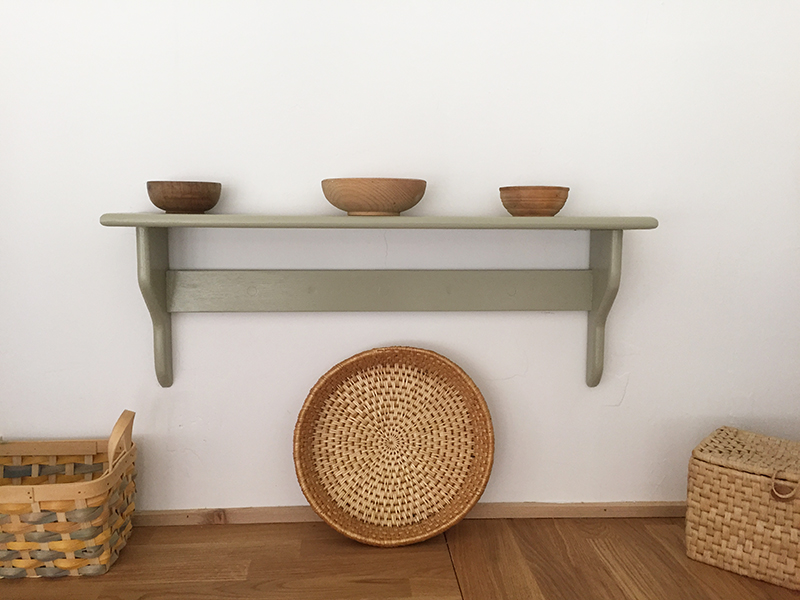
    Over the following years, I interviewed Miriam on my former radio show, Food For Thought. In none of those conversations did we speak of her work as an artist. Yet when you make your way through the Genesis Farm gardens, walk along the woodland paths, and the moss covered trails around the pond you see the work of the Divine present everywhere. Look inside the straw bale buildings you will find simplicity in the furnishings, bare walls, and deep window sills. There a religious icon can be seen framing a birds nest holding a blue marble of the earth; suddenly you know there is another artist at work here.
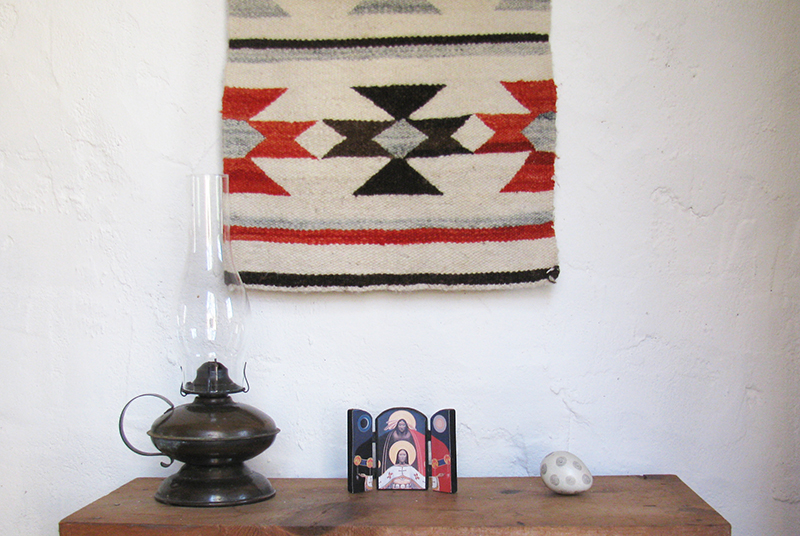
    I asked Miriam for this interview because I wanted to hear her tell the story of how she, as an artist, shaped this vision that has become Genesis Farm. We sat outside in the Founders Grove, whom she has each honored with an art piece that speaks their presence in the shady grove.

    I offer you the interview in two parts as I feel Miriam’s is a life worth contemplating slowly, savoring the evolution of a visionary artist creating her masterpiece.

    What were your creative beginnings as a child?
    When I was a child around 9 or 10 years old, there was a Sunday television show, Drawing with John Nagy, which I lived for, and I was so absorbed in watching that, but I had no idea that I had any talent. We were poor, we lived in lower Bayonne, and I would think, ” I could do those pictures if I had charcoal,” or things like that. That was my awakening when I was a little kid. I had a natural talent, but nobody knew it. My older brother Bobby, had talent and everyone recognized it, and I was in the background then, but it did not matter because I was into horses. When I went to high school, my teachers recognized my talent, and they would ask me to do sketches for the literary magazine or the newspaper.

    Later the sisters in my congregation recognized that I had a talent and they encouraged me to go out to the University of Notre Dame and study art. I was maybe 22, and my first degree was in education and English. I had no background in art, and at the time I was a first-grade teacher.
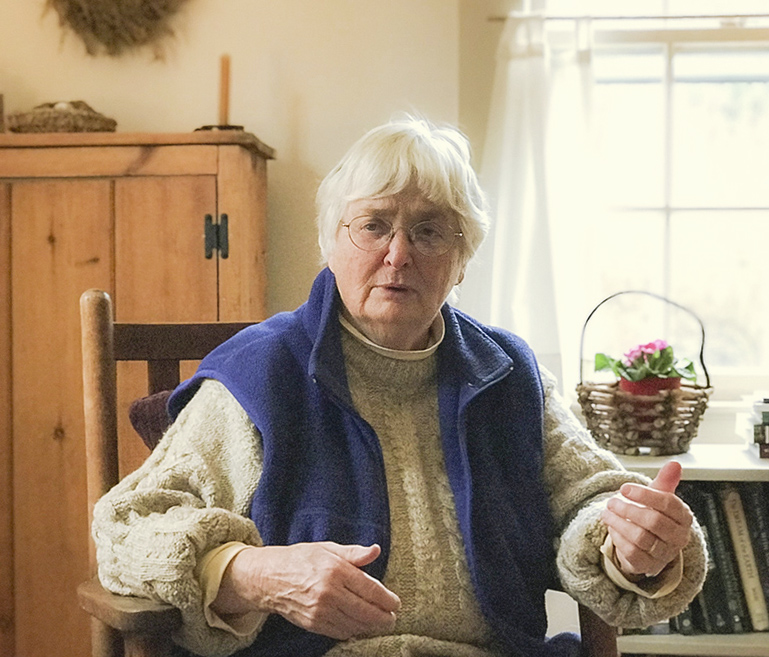
    How old were you upon entering the convent?
    I was 17. I had just graduated high school the summer before and entered the congregation in September, and that was not unusual, half the girls in my class got engaged at 17. Very few went to college; we were a struggling working-class culture, college was not in my plan.

    Did you know at a young age that you had a calling to enter the convent?
    Well, I think like many of the people in my time, I was born in the forties, we came out of the depression in the thirties. As an immigrant culture living in Bayonne and there were a lot of Irish Catholics and Polish, Italians, Slavs, and in those days my childhood was in a religious faith milieu. It was the most meaningful system of that time. So, my mother said, I was driving her crazy at four years old because I had taught myself to read, so she begged the principal to let me start school, and I entered a real traditional Catholic school, and the sisters were like saints to me. The church next door to the school was the most beautiful space I had ever been in my whole life, and the stain glass windows were gorgeous, and when you were in there, you were in another dimension.

    And that is where my soul woke up, my mystical aspect and I think my esthetic one too.

    When I was in high school everyone was asking, are you going to go to secretarial school, are you going to go to nursing school, are you going to get engaged? What are you going to do? Girls did not have the opportunities, not in our society anyway. I knew I would be bored with any of that, and the world of religion and God and that relationship was so sharp and so intense, I just sort of knew that’s what I needed to do.

    I was a postulant for one year, a novice for two years, I was a scholastic (a further student), at the college level for another year, then was sent out to teach first grade in West Orange, and that is where they decided I had talent. So, two things happened, one is “you’re going to go to University of Notre Dame and get a Masters in art.” I didn’t even have a Bachelors in art. Except for charcoal from John Nagy. And secondly, we’re sending you to St. Dominick Academy in Jersey City, and you’re going to teach art.
    In those days you just did what you were told. So that’s what I did. I was so lucky to have the sister, who was the principal and herself an artist and she realized how could I teach any of these subjects? I had never picked up a watercolor brush…so she would coach me, usually at night or on the weekends for what I was going to do with the high school kids…and they were fresh kids.

    I also had to learn photography, because the art teacher historically had the yearbook, and the previous art teacher gave me this camera, a Hasselblad, the Cadillac of cameras, and here I am, never had a camera in my life. I had big shoes to fill, and my saving grace was that I really got along well with the kids and they really liked me. I would teach during the school year and in the summer go out to Notre Dame to do my studies. And in those days, the early sixties, Notre Dame was still an all men’s college. Women were not allowed on the campus to study; you could only go in the summer when the students were gone. And the University just changed its whole orientation towards religious; there were thousands of priests, brothers, sisters and the Vatican Council had these amazing theologians and thinkers advising the Pope during the council, who were invited by Notre Dame to come out and be lecturers.

    Now we had never heard of any of this kind of stuff. I grew up with the stained glass windows…so it was huge to go out there and listen to thinkers saying things I thought was almost heresy. It contradicted almost all my beliefs, and then I would go home, go back into teaching, studying, and trying to figure out what they were talking about. Then the next summer go back out again and hear more, and that was a ten-year process because I could only go in summers to get my Masters.

    Wasn’t that the time the Vietnam war was starting up?
    Yes, it was 1968, I was still teaching at St. Dominic’s, the racial riots had happened in Newark and Jersey City. The leaders of our community were deeply committed to intervening on behalf of the poor and the blacks in Jersey City and Newark. Then the war got really bad, and one of my high school students challenged me about what did I think about that war. I was completely unconscious, and she kept asking me questions, and I couldn’t answer her questions. By the end of that year, she gave me Daniel Berrigan’s play, “The Trial of the Catonsville Nine,” which was the story of them burning the draft records in Catonsville, Maryland, and he made a play out of it, on Broadway, and that was it. That was my major conversion.

    Did you put these new thoughts into political paintings?
    Not thoughts, just painting, I was just painting. In those days I wasn’t that politically savvy. It started a fire in me, and then I had to go to Sister Julia Barie and Sister Vivian, and my brother Bobby who became a soul partner. He had six kids up in Connecticut, and on summer vacations, I’d get a couple of days off, and I’d go up there, and we’d go off photographing, and painting, really critique each others work. It was a wonderful, wonderful relationship; and so I’m saying to him and my mother and my family and the congregation,

    “I’ve got this Masters degree that you invested in me. I know you want me to take over the college art department at some point, I can’t do it, I’ve got to follow these bigger questions.”

    Now, this was all happening late 60’s, early 70’s. I was still teaching at St. Dominic’s, going through this inner struggle, and I was sent to Lacordaire school in Montclair. That easy rapport with the kids at St. Dominic’s, street kids, they weren’t rich kids like at Lacordaire. These were from really wealthy families and so spoiled, and I had to deal with a whole new culture, but they were so emotionally needy, and I could see that fast. And they were also extraordinarily talented. That school only had 200 students, and 50 of them were art majors. I was sent there to start an art majors program, so it was four years. A student came in as a freshman, and I was preparing them for universities, colleges and art schools, and they went to them, it was a wonderful time. I loved teaching, but all through that time I’m struggling with the war as well, and I’m accused by the parents of being a communist. I’m hauled into the Department of Education in Newark and “she’s a communist, she’s on the side of the Viet Cong,” I mean it was awful, awful, a nightmare.

    The Jane Fonda of the convent…..(laughter)
    Uhhum. And Liz McAllister, who was also a war resister and married Phillip Berrigan, she had gone to Lacordaire, so this Monsegnier down in the Department of Education, he was acting like he knew what the war was about, and Liz McAllister and what they’re all about, and I’m on trial….(laughter), it was crazy. Anyway, I spent four years at Lacordaire, and that’s when I probably would have left the Dominican Sisters because I was isolated. It wasn’t like I didn’t have friends, they just didn’t know what I was talking about. My family didn’t know what I was talking about. My brother didn’t know what I was talking about.
    So you are growing and evolving, and everyone is staying still?
    Or they’re in their own important worlds, but I was gone, you know? So, Sister Vivian, she knew something was going on in me, and she said to me, “Ya know, there is an opening for an intern position at the Newark Archdiocesan Office of Justice and Peace. And she said, “Father Propracter is a wonderful man, would you like me to introduce you to him, maybe that position would be available to you.”

    Now no-one had ever done anything like this in our congregation. We were all school teachers.

    I went down to his office in Newark and met with him. I told him I was interested in the racial situation, and the labor unions, which was the most important topics there; that’s what they had been focusing on. But I told them that I was really, really concerned about militarism and war; and I want to be involved in studying what is going on. They opened a global desk, and I was the Captain of the global desk (laughter), I didn’t know what I was doing, I had no background.

    How old were you at this time?
    I was 31. I worked there one day a week as an intern, and then at the end of that year, they hired me full time. I worked there until ’76. In that period of time, I met Pat, and Jerry Mische, who were the founders of Global Education Associates. I was working in Newark, and their office was in East Orange, and they had strong ties to Seton Hall.

    Are you doing any art during this time?
    What I was doing was sketches for newsletters, just that kind of stuff. Actually, when I left teaching art, I really put down my paint and brushes. I knew I had to make a choice. If I was going to be a painter, I was going to do it 100 percent. I couldn’t. My paintbrushes are in a little shed behind my house. I keep thinking before I die maybe I’ll pick them up again.
    But that’s interesting they’ve traveled with you, they’re always there.
    Yes, they’re there, but that hasn’t been the way I’ve done art. I would do it whatever way it was connected to the work I was doing. And then when I went to work for Global Education Associates, they had a journal that they put out called The Whole Earth Papers. I became the Art Editor of that and did all of the graphics and all of the sketches. Here in our library, we have the whole index of those. And that’s when I began to do political cartoons, and political drawings and stuff. So that was in the 70’s, but by ’74 I was very focused on world hunger. Because that’s what was happening, and the United Nations had its first world conference on hunger; and established the UN Center for Food and Agriculture in Rome.

    Global Education, GEA, was very connected to the United Nations, and the kind of structural changes that had to happen to get people past Nationalism, and they identified Nationalism as the fuel for war. I was concerned about peacemaking and ending war. And they were to, but they came at it through analysis of global systems. I was doing research on world hunger from ’74 straight through. That’s what I knew most about, was distribution issues around food. I really learned about the food supply, and agriculture and the history of agriculture and the distribution system and corporate takeover. Then the chemical phase of agriculture when industrialization happened.

    I had all that background that I was doing theoretically, and speaking about, and traveling, and writing, when the Baron left this land to the Dominican Sisters.

    It’s interesting, isn’t it, that you were prepared? ….or sort of!
    Well, if I hadn’t had that and they inherited a farm, and I’m teaching art at Lacordaire…….

    Ok, so now the Dominicans inherit the land that is to become Genesis Farm, and you are how old?
    I was 38 when we got the news, 39 when the whole congregation was invited to write proposals to see if they had an idea, but they had to have their own funding because there wasn’t going to be any money from our congregation. Our congregation went into debt to do a settlement with the daughter who contested the will, and so did the other two beneficiaries. She was settled out of court so it wouldn’t go on forever. The Sisters went into debt to provide her with that settlement, so there was no money to subsidize what was going to happen here. If you had a thought as to what you wanted to do at Red Cat Farm you had to have a business plan and submit a proposal by such and such a date to the leadership team. So, we made the whole thing up, we didn’t know what we……

    But why did you want a farm?
    There were a couple of reasons. The first one was, by 1979 after studying hunger, farming, and agriculture; I just had this longing to have some way to put it all into practice. I had become a vegetarian in ’74 when I realized the injustice of food distribution. And I remember reading Francis Moore Lape’s book Diet for a Small Planet because she was the writer in those days talking about diet. Her work guided my personal choices.

    She wrote that if the food the animals were eating in the feed lots of Chicago…if that food were distributed around the world, there would be enough food for everybody. I couldn’t make that equate. How could they feed those animals when in those days twenty-five thousand people a day were dying of starvation. It was just incomprehensible to me. That’s when I decided to become a vegetarian.
    Your original intention then was to take Red Cat Farm and grow food?
    I had already started to explore a couple of retreat centers, and there was one down here by Chester called Bethlehem. This priest ran it, and it was hermitages. His name was Gene Romano. I made a retreat there, and I said to him, “What if you hired me to grow the vegetables, and I cook the meals and put them out for the retreaters. It was small, you might have five people. By then I was a good cook because I had learned in Jersey City. I suggested that if we had a little card that said, ….the reason we are serving this food…and then you gave the rationale for why…. and it was really delicious…it was a way to shift peoples perception because everybody was eating an American diet.

    He was very open and we were exploring that, because I knew I still wanted to be working at GEA, but I could be doing this as well. That’s when we got the word that our proposal about the farm had been accepted. So, you see I had already been transitioning in my work.

    The wheels were in motion!
    Yes, the wheels were in motion. I came out here to the farm in May of 1980, and I had just turned forty.

  • Black Snake Medicine

    I am in the midst of moving my possessions once again
    It all happened suddenly, unexpected, a complete surprise
    One day I was contemplating new plantings for the garden
    And the next I was contemplating suicide as an alternative
    Then Kate Spade and Anthony Bourdain settled the question
    If you have achieved everything, and still off yourself
    Then their despair, their pain must be greater than mine
    So I did a few sun salutations and got on with living my life.

    I had been assured I could stay in the Stone House
    Who wouldn’t want to awake to the sound of birds singing
    Coyotes yipping and howling on a crisp full moon night
    Beavers slapping their tails during my evening stroll
    Black bears wandering through for a dip in the pond
    The wild bobcat eying my cat Tessa with lascivious intent
    Newly hatched ducklings fleeing across the water’s surface
    As a proud old falcon perched on a tree branch waits to strike.

    I have become one of natures creatures here on this land
    Suddenly I am free falling into empty space, unsure of myself
    I imagine a climber on the El Capitan cliff face losing the grip
    And dropping before the lead line catches with a sudden jerk
    The breath stops, heart races, eyes momentarily cloud over
    I am that for maybe a day or two, to long if you ask me
    But nobody asks, they don’t want to know the feeling because
    They know the feeling and don’t want to relive it over again.

    Soon after, a black snake arrived to ease my landing
    I had created an art studio in the basement of the house
    One day I found an abandoned snakeskin hanging from the wall
    With a second glance, I saw what appeared to be a black feather
    When I reached for it, for you see, I have a collection of feathers
    It shifted, moved, grew eyes, and a long black neck extended
    Contemplating, inquiring after who I was and what I needed
    I recoiled in fear thinking my life in danger, but it was not, never was.

    Yes, I admit, I googled her, this black snake invading my workspace
    And she turned up harmless to me and deadly to rodents, mice, rats
    But she also spoke of transformation and the life-death-life cycle
    The same cycle that seems to follow me from one life change to another
    “You are always reinventing yourself,” I am repeatedly told by friends
    As they watch me repeatedly reinvent my life to create new growth
    Black snake reminds me that I am merely shedding my old skin
    That I am to prepare for a new one that will bring transformation.

    When black snake returned, again and again, I photographed her
    At the window, on the wicker chair, sliding through the deer skull
    I filmed her moving across the brick patio and into the woodpile
    When she stretched out of her nest, I took a photo then too
    And when she came to me in my dream, I was no longer afraid
    I layered the images together, and one by one a mandala emerged
    Black snake medicine, totem, guardian, kundalini rising, speaking
    For those skeptics I say live in nature, know that you are nature, listen.

    The move is now complete, and it is time to mourn my loss of home
    I dream I am curled like a snake round all the things I left behind
    Black snake tells me to release the past, trust in the birth occurring
    The old skin left behind will fertilize my connection to mother earth
    When I woke from this dream my wild soul ached to howl, to be heard
    Shedding this tough old skin was not so easy now that I am older
    I have left behind so many skins in a long trail marking my journey
    Once clouded, soon clear, my eyes behold a new life beginning again.

  • Song Of Suburbia

    In the city of darkness
    There are those who weep
    Those who sing love songs
    Piercing cries to God for mercy

    In the suburbs at dusk
    Lives with shattered dreams
    Eat gourmet dog food
    Off of silver dishes

    All along the lanes
    To the end of the circles
    Lights are springing on
    Another day’s gone by

    We try to hold it together
    Save face while dancing with the rest of the world
    America, the dynamic leader, is a closet bulimic
    Consuming as fast and as much as possible
    It is all just as suddenly vomited in a neatly tied
    Wrapped in plastic, garbage pile deposited
    At the edge of the front lawn
    Early in the morning, it is picked up and
    Carted off before we see the extraordinary waste
    Sucked up into Mommies’ belly

    Sing all for the American way
    With single shots of red, white and blue
    What will the people say?
    What will the people do?

    Some warriors will throw stones
    The masses might protest
    Many will be killed by the police
    Some will criticize the government
    Others will sit and watch the drama unfold
    Mumbling curses under their breath

    Most will do nothing
    The people will do nothing

    Addicted to medications
    Minds frazzled
    Bodies broken in pain
    The people are unconscious
    To the horrors of what is coming
    Detention camps being assembled
    To imprison those who resist

    Cry America, cry
    Shed tears for your homeless, your sick, your poor
    Die America, die
    Or together in peace, we can create the cure

    (Excerpted from Songs & Poems From Suburbia© by Delia Quigley. To be published Fall, 2018.)

  • The People Are Tired

    The people are tired
    Their bodies strain under weight
    loaded with sugar and white bread
    The pain of living is dulled
    by medications legal, mostly illegal
    Life holds little meaning
    pleasure and pain only
    Churches have closed
    All denominations shuttered
    Entitled children wander
    across the internet
    looking for a sign of god

    We turn to animals
    to find unconditional love
    Then hold them hostage
    in crates and chains
    So they cannot run away
    from our demands
    to be loved in return

    The earth spins on
    precarious on her axis
    Encased in toxic fumes
    that we all have created
    We live in crowded cities
    Atop exploding mountains
    Along the receding shores
    We laugh, cry, sing, dance
    We make love and
    hold tight to shameful secrets

    Eventually, we are destroyed
    by the very things we bury
    Beneath a constant barrage
    of garbage, information we
    create true or false, lies and deceit
    Observe now our dying species
    for once we are gone
    only our artists creations will remain
    All else will return to the earth
    Dust to dust

    And from the forests
    the crates and locked rooms
    Animals will slowly emerge
    Once beloved pets and friends
    joining with the wild untamed
    They will begin to repopulate
    They will return Earth to Eden

  • Linda Welles is a funny, multi-talented woman with a long list of friends, a happy marriage, and beautiful home perched along a series of waterfalls. I knew her reputation as a killer cook, and for the artful renovation of a historic colonial house, that can be considered a paradise on earth. We spent an afternoon walking the land, talking about art, life, food, people, our dogs, loves, and need to be always creating. And of course, we laughed a lot, because that’s what you do with Linda. She feeds you food, drink, thoughts to live by and always with a sense of the dark and light side of life’s funny bone. Here she is to tell her story.

    How would you describe yourself as an artist? Has it changed over time and where are you now in your creative process?
    This was a question I had to think a lot about because I’ve never used that term when I think of myself and whatever I’m creating. The word artist is so subjective, elusive even and society has a precise definition. I’m more of a creative dabbler if that makes sense. For me, it’s more about observing, stopping to listen, to feel, to problem solve. It’s taking what’s inside my head and putting out in the open. It’s an expression of myself and a form of meditation and therapy. I can lose myself for hours in a project. I’m not thinking of the minutiae, but concentrating on what is and what isn’t; how and what I perceive and how best to communicate that perception.

    There’s problem-solving involved which I love. Figuring out how to shape and make something coherent out of perception. Again, this process for me is therapeutic and slow. It takes a certain amount of courage to put ideas into a tangible form, but it’s exhilarating when it works!

    Beauty, in the eye of the beholder, can evoke a positive (or sometimes negative) response. I embrace all that is beautiful and so try to surround myself with it whenever I can.

    How many different modalities of art have you done?
    Different modalities of art that I’ve experienced include the following:
    Oil painting– as a young teen, my mother and I would attend art classes together. It was a beautiful and rewarding experience. I learned a lot, and it deepened my passion for art.
    Pen and ink– in high school this was my medium of choice. I loved the intensity of it. Unfortunately, I have very few examples from that time. I gave them away to friends and lovers.
    Acrylic painting– I minored in art in college (thinking that I’d go on to become an art therapist) and for several of the classes, the medium required was acrylic paint.
    Weaving– Fabric and basketry-I love clothes and fabric and texture and design. So I played around on a simple loom with my special education students and was intrigued. I’ve taken several weaving courses over the years and even have an eight harness LeClerc loom. Those weaving classes lead me to basketry classes offered privately by a woman in Washington, N.J. We both loved it so much that we started a small business called the Basket Tree. It lasted for several years.
    Jewelry– I took several jewelry classes in college, and at an early point in my marriage, Chris got interested in it, and we would make and sell jewelry.
    Papercrafts– paper is a fantastic medium, consider the work of Henri Matisse. I’ve engaged in making paper, creating collage pieces, folding intricate origami and making prints on paper and fabric.
    Knitting, crochet, and embroidery are all handcrafts that I’ve learned over the years from my mother, grandmothers, great aunts, and friends.
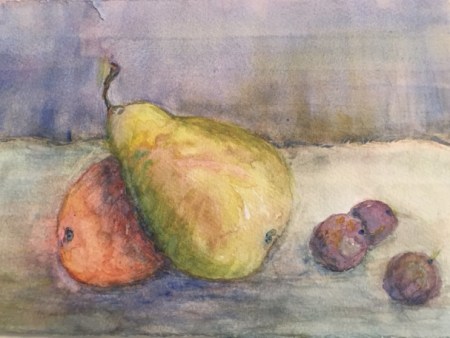
    Watercolor painting– This medium is my newest and favorite love. I’ve been at it for about three years and still know I have so much to learn. Three years ago I took a watercolor class, and it was what I needed to reduce stress in my life. I can lose myself for hours when painting. Regarding a medium that’s portable, requires little space and clean up, and is diverse, it’s perfect.

    Did you grow up in an artistic family?
    Yes! My mother had an excellent eye for art and was in her own right a good artist and craftsperson. She produced some lovely oil paintings which I still have. Her hands were always busy. She was a fabulous knitter and seamstress, creating clothes and blankets and other household items. In later years, she knitted for charity, making many blankets and baby hats for children who were ill. She was the ultimate volunteer. While working at the Hamilton House in Clifton, N.J., she discovered rug hooking and was “hooked.” She produced many beautiful rugs that grace our home today. In addition to her many craft pursuits, she loved to cook and elevated that to an art. My Hungarian and Italian grandmothers were also excellent cooks and to watch them in their kitchens was like observing a ballet.

    My father was a Rube Goldberg artist. He was the guy who could create something from nothing, an analytical tinkerer. He always invited me to his workshop and patiently explained his thoughts and methods. I learned a lot from him. My brother is a master carpenter and has been making his living that way since he was in his 20’s.

    In addition to my family, I grew up in an ethnically diverse and culturally rich Hungarian environment. The smells of various ethnic cuisines wafted from individual houses as I walked down the block. People planted small garden plots in their backyards and tended ripe red tomatoes and juicy figs. Things were often done the “old-fashioned” way, from scratch. Neighbors invited you in and shared stories, laughter, and food. Being in such environments, surrounded by other cultures, helps to make one see things in a broader more global sense. It piques curiosity and creates questions.
    I lived, by bus, 15 minutes from NYC. While I was in high school, at least once a week, I’d hop on that bus and journey into the city to go to the Village, a museum or a dance performance. All of these experiences added to the formation of who I am today.

    Your creativity seems to include painting, gardening, cooking, renovating old houses, interior design and fashion. What are your thoughts on these?
    Living in an environment that is pleasing is good for the soul. I have a diverse number of interests including, but limited to, art, cooking, antiques, renovation, crafts, indoor and outside gardening. Whenever I’m starting a new project, there’s always a certain amount of research to be done. As it progresses, all of my knowledge of color, creativity, design, and artistry comes into play whether I’m cooking a meal, arranging a bouquet of flowers or rearranging the living room. Sometimes it’s a conscious effort, and other times its innate knowledge. In other words, what you see surrounding me is an extension of who I am.

    How do you share your artwork with others?
    Lately, I share my art with others mostly by giving it away. When I had a basket weaving business with a colleague, we offered them for sale, but I find it most satisfying and rewarding to create something for someone because I’m inspired to do it. For example, every Valentines Day I make a special card for my husband, Chris. Over the years, I’ve created cards using a variety of techniques. In the past several years, though, I’ve started to paint miniature watercolors for the cards. Creating something with a particular person in mind is what brings me the most satisfaction.

    What intrigues you the most about the creative process?
    What intrigues me most about the creative process is getting there! I mentioned before that there’s a lot of organization that goes on in my head before I get going on something. I need, in my mind, to feel ready, to feel committed and prepared. Sometimes that’s a slow process. Also a bit of pressure, whether it be from the outside or internal helps to get the juices flowing.

    Of course the best part of the creative process, for me, is the end product; even if it’s not what I originally envisioned. And if it’s not, I like to analyze what went wrong and how to make it better next time. The other aspect of the creative process that intrigues me is how expansive it can be, the way that one facet of, say cooking, can lead to another. The possibilities are endless. The learning experience is boundless and will continue throughout my lifetime.

    Looking back would you have lived your life differently?
    An interesting question and initially I’d say yes, then suddenly change it to an emphatic NO! I think, looking back over one’s life, we all have regrets….” woulda, shoulda, coulda.” But if you live your life with regret, can you ever grow? We all imagine different scenarios if we had done this or that, but if I had done things differently, would I be where I am today?…….. With the knowledge I have today? Knowing and loving the people, animals, places, and plants that are in my world today?

    “Be here now” is a mantra that I often repeat.”

    So I forge ahead with gratitude for what I have here and now. I am truly blessed in many, many ways. I have been afforded many opportunities in my professional and personal life that have changed me and hopefully, others too. I am no Pollyanna with a Cinderella ending. There’s still lots of work to be done, and as long as I stay open to new experiences, people, information, I can continue to live a fulfilled and satisfying life.

    What would you say today to your younger self?
    To my younger self, I’d say a lot of things, but most importantly I’d ask her to remember that timing is everything. I’d tell her to be more careful with herself and trust her deep intuitions. And finally to live her life fully with no regrets.

    What would you say to young artists coming up in the world?
    To young artists coming up in the world- start now! Diversify. Immerse yourself in your art. Seek out every opportunity available, put yourself out there. Find a mentor and suck up every bit of knowledge they can give you. Network. No task is too menial. Think outside the box. Try it and if it doesn’t work, keep trying. Be open. Be free. Work hard. Accept criticism. Be thoughtful. Smile a lot.


  • Ralph Waldo Emerson

    “Every person I meet is in some way my superior, and in that way, I can learn from them.” ~Ralph Waldo Emerson

  • Creation As Meditation

    The creative process is to me the eight limbs of yoga practice. Even the breath is essential …prana….life.

    I prepare my body with asana, then connecting to the breath I slowly begin to distill and concentrate my senses: sight, sound, touch, taste, smell, so I am awake, intensely alert in the moment.

    My concentration is intense and focused like a laser light beam on the story I am telling, the photo I am taking or the image I am bringing to life.

    The world falls away, mindless chatter becomes nonexistent or white noise. My mind embraces a new way of seeing.

    Just being.

    I move into a state of meditation where there is only me and the creative mystery.

    Here I find my bliss, my happiness.

  • What She Really Wants
  • Alan Watts Quote

    You are an aperture from which the universe is looking at and exploring itself.

    ~ Alan Watts

  • Aboriginal Mandala
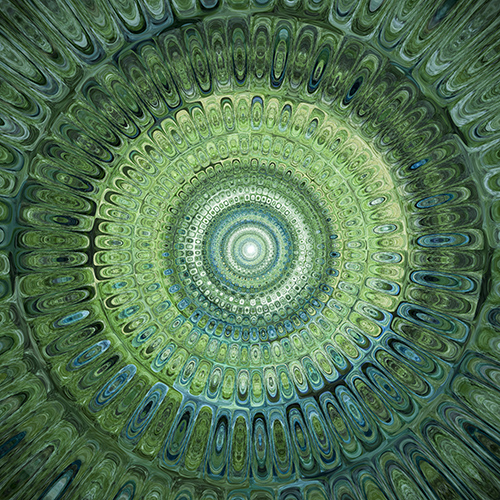
  • Mandala’s can tell your story
    I know
    I was once a reader of mandala’s

    At my retreats
    I would have women color mandalas
    To pass the time
    Calm the body-mind
    Sit together in quiet conversation
    I would lay out books filled with mandalas
    And ask them to choose a design
    One that called to them
    Then take colors and fill in the blank spaces.

    One day someone asked me
    To read her mandala
    She handed it to me and in the taking
    I suddenly saw her life laid out
    In the design she chose
    The colors she used
    Dark and light, hard and soft
    I read her story as the other women listened
    The images rose up in my mind as I spoke words
    I had not planned to say.

    The woman looked at me and smiled
    And to the other women told her story
    It was as I had seen a dark past, terrible struggle
    But now a time of light, love, and redemption.

    Another mandala pressed into my hands
    I glanced down and knew there was trouble
    I hesitated to speak, but the words rose in my throat
    “Have you been to see a doctor recently?”
    The women gasped in surprise
    Her mother and sister sat across the room
    Stunned and afraid of what she might say
    Then after a long moment of contemplation
    She answered, ” Yes, the doctor thinks I may
    have ovarian cancer.”
    It was there in the design she had chosen
    In the colors, she used to tell her story.

    Year after year the women returned
    They colored their mandalas knowing enough
    To attempt to disguise their secrets
    But still, it was all there to be deciphered
    I had to look longer, listen deeper for the knowing
    But the truth always reveals itself
    In the design you choose and the colors you
    Use to paint the story of your life.

    Today I create mandalas
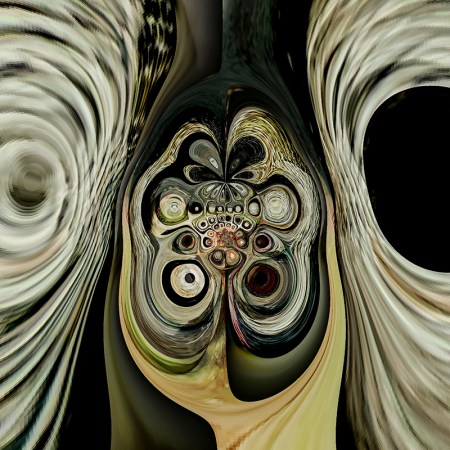
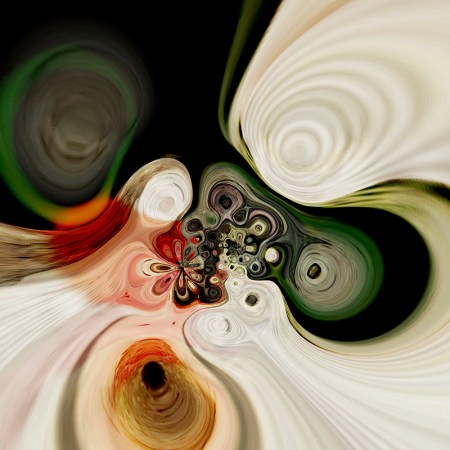
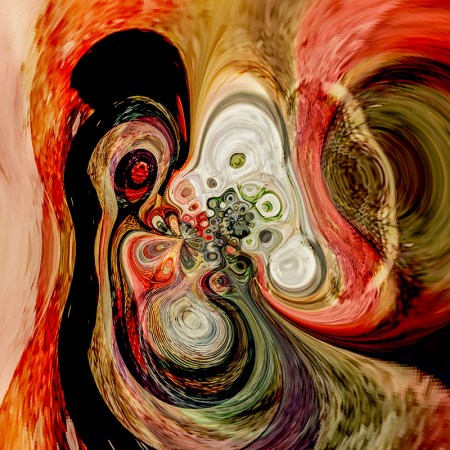
    From images, I take of people and their art
    Of aboriginal paintings blended together
    Or natures many offerings to my creative eye
    The photos are first blended together and then
    Take on a life of their own swirling into patterns,
    Blocks, merging colors, words, time, eternity
    They speak a new language, and all I do is listen.

  • I Exist

    I exist as I am, that is enough,
    If no other in the world be aware I sit content,
    And if each and all be aware I sit content.
    ~Walt Whitman

  • Thoreau Quote

    According to Henry David Thoreau: “It’s not what you look at that matters, it’s what you see.” That is true in art, and it is true in life.
    ~Sharon Pontier

  •      I don’t remember the exact moment I met Sharon Pontier. It was probably a summer morning in 1998 when she was on break from teaching school, she arrived for a yoga class at my small schoolhouse and is still practicing her yoga and meditation with me all these years later.

         I’ve watched her mature as an artist, as a woman and as a human being always willing to put herself on the line against injustice and war. We have traveled together to protest in Washington D.C. against torture and talked long into the night on solving the problems of the world. And all along she quietly paints her watercolors and creates her collage pieces encouraging others to follow their artists’ muse.

    How would you describe yourself as an artist?
    Being an artist might be a state of mind, as well as a person that works with paints, pens, pencils, paper, and so forth. I think it has a lot to do with the need for and aptitude towards creativity.

    Although I consider that I am mainly self-taught, by now, I have taken a great many courses with known professional artists. Among those artists are Peter London, who wrote, “No More Second Hand Art” and “Drawing Closer to Nature.” Jane Davies, an abstract artist, whose class I took at Omega Institute, and she has published various books on both art and craft. She also offers online classes and videos. Also, most recently, I took a course on collage with Jonathan Talbot, internationally known as a landscape painter and collage artist, who also has published on his methods. He also wonderfully has exhibited in our small UU Fellowship Gallery.

    According to Henry David Thoreau: “It’s not what you look at that matters, it’s what you see.” That is true in art, and it is true in life.

    You are active in the Peace and Justice movement, how does this affect the art you create?
    It is important to me that justice in this world prevail. What I see very often is an injustice, and a world in disarray…a world where there is terror and war. I see it and wish to respond to it. I do that by joining with others in protest, calls to congresspeople and through my art. There is no peace without justice, and most of my life I have participated in actions that I hoped would lead to justice and peace. Much of the art I have collected over the years has to do with social issues. Now I try and integrate that perspective into my work. In the gallery at the UU Fellowship, we try to focus at least one exhibit on humanity or social issues.

    John Berger said: “art…is a form of prayer.” I do see art as a meditation, as well. Meditation and prayer separate the person from the busy mind and reach deeper into the soul so that thoughts and actions are moderated and considered. A deeper creative space is achieved, the art becomes purer. Meditation is then another level of seeing.

    How did you make your living and also include the creative process in your work life?
    For over 30 years I made my living as a teacher in private and public school. Teaching itself reaches a profound creativity allowing me to draw on it and awaken this creativity in my students. Art is an excellent basis for the creation of classroom projects as well. When I taught very young children, putting up there work, their pictures were a joy…..the work called out to be observed and experienced. It turned creating bulletin boards into an art form.

    You curate an art gallery in your church, what made you decide to begin this venture? How has it evolved?
    The Art Gallery at the UU Fellowship came out of a discussion with a number of people. The space that we use is a lobby proceeding the sanctuary. Previously, it had become cluttered with notices and so forth. After clearing off the bulletin board and painting it white, I was asked not to put the notices back up. Remembering discussions about an art gallery, it occurred to me that we could put up art work, so I asked around to different UU Artists and others for paintings on water. A water ceremony is the first official service in September when our services restart after a summer break. This gallery was such a pleasant surprise to everyone that all were willing to experiment with the project. It remained successful, so it continues.

    What advise would you give your younger self?
    There is a paragraph that I recently read: In ‘Courting the Muse,’ a writer alludes to what Katherine Mansfield called ‘hard gardening’: the hard work of giving time to the creative act, to summon something deeper. I think that is what I would echo to my younger self…in becoming, keep searching for the ‘something deeper.’
    How would you advise young artists starting out in life?
    Art can be found in any field, so get a good education and keep an open mind to the profoundly creative aspects of life. Continue to grow and know that one learns and becomes all of one’s life.

    The UU Fellowship Gallery is located at 1 West Nelson St., Newton, NJ. Hours are Sunday’s 12:15 – 1:30 PM or for a private viewing contact Sharon at 862-268-3858 to arrange an appointment.

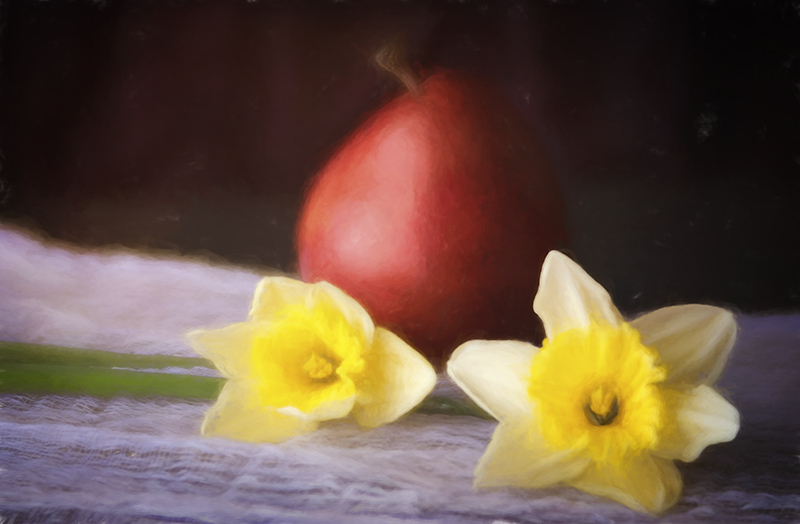
  • A Love for Daffodils


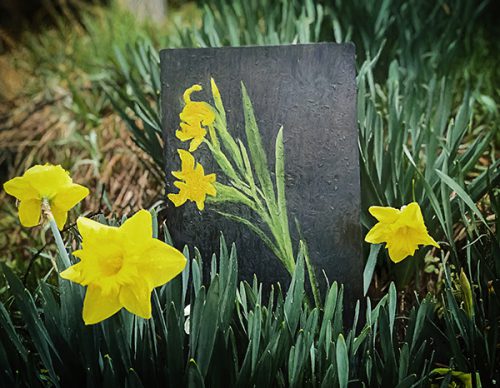
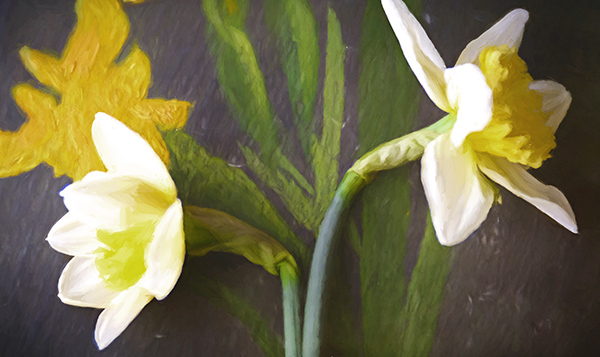
    My friend Barbara Kulicke loved to paint flowers. Her garden was lush with variety, and she would spend hours sitting on her small chair weeding the beds.

    She is gone now these past few years, her garden beds full of weeds and only the heartiest of flowers make it up to the sun. The daffodil being one. Abundant and determined they spring up out of the earth eager to reach the sun and thrive for a brief moment in time.

    to me the daffodil is the flower for Aries
    yellow like the sun
    fire element
    so many layers of color
    texture
    then the stamen
    first flower of spring
    pushing up through late snow
    bent double in spring rain
    a brief lifespan
    and then gone
    like you and me

    Barbara loved to paint on slate, the foundation of this ridge and valley area of New Jersey. She gifted me one of her paintings, and when a few daffodils suddenly opened, I lay them across her vision of this amazing flower and called her memory back into the world.
  • Into The Trees